Shop Catagories
00

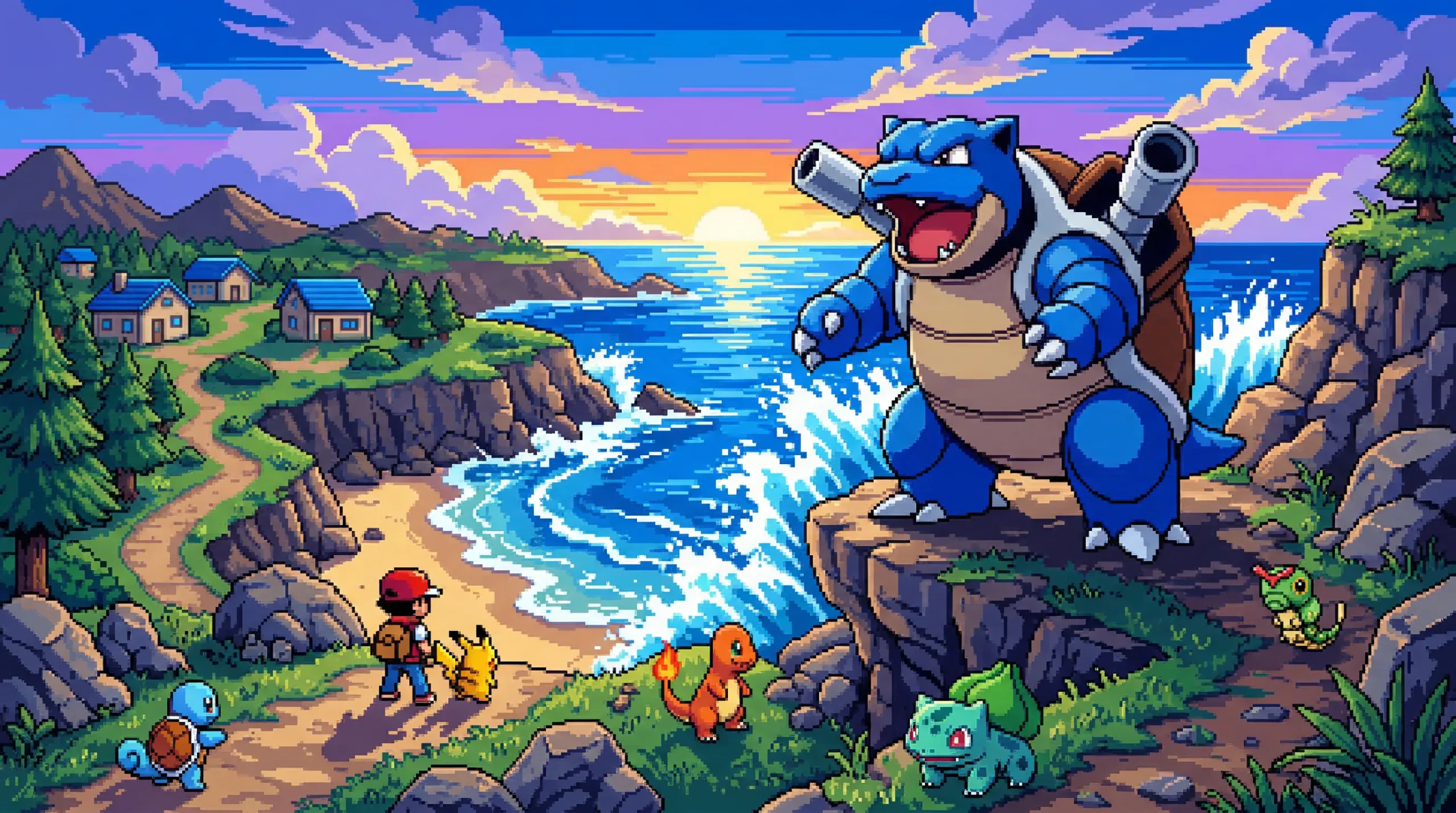
In February 1996, two small cartridges for Nintendo’s Game Boy quietly launched in Japan and changed entertainment forever. Pokémon Red and Blue — or more accurately, Red and Green, with Blue initially a special edition in Japan — introduced the world to a concept so elegant and compelling that it spawned the highest-grossing media franchise of all time. When the games reached Western shores in 1998 and 1999, they arrived in a fever pitch of anime-fuelled excitement. Pokémon Blue Edition was the version that millions chose, and for those who started their journey with Squirtle, Charmander, or Bulbasaur on a Blue cartridge, the memories are indelible.
You are a young trainer from Pallet Town, about to receive your first Pokémon from Professor Oak. Your journey takes you across Kanto — from the rocky paths of Pewter City to the electric towers of Vermilion, the lavender graveyards of Lavender Town, and the neon spectacle of Celadon. Along the way you battle eight Gym Leaders, dismantle the criminal operations of Team Rocket, and face your childhood rival at every turn. The story is paper-thin by modern standards, but its simplicity is part of its genius — it exists to frame the core fantasy of adventure and discovery, which it delivers with perfect economy.
Pokémon Blue’s turn-based battle system, built on the concept of elemental type advantages and disadvantages, was accessible enough for children but deep enough to sustain competitive play for decades. The ability to catch, train, and trade 151 distinct Pokémon — each with different stat profiles, moves, and evolutions — created a collectible RPG of unprecedented breadth for a handheld device.
The Game Boy Link Cable was integral to the Pokémon experience from the start. Certain Pokémon, like Kadabra and Machoke, could only evolve through trading. This designed interdependence made Pokémon fundamentally social, encouraging players to meet and connect — a prescient design decision that anticipated the franchise’s community-driven future.
Pokémon Blue contains a roster of version-exclusive Pokémon not available in Red — including Sandshrew, Vulpix, and Scyther. This clever design decision made owning both versions (or knowing someone who did) feel meaningful, driving trading activity and deepening the social dimension of the experience.
While ostensibly linear, Kanto offers genuine freedom — certain areas can be approached in multiple orders depending on which HMs you carry. The feeling of discovery as you enter a new town, find a hidden item in tall grass, or accidentally wander into a cave and encounter a Pokémon you have never seen before is one of gaming’s purest pleasures, and Blue delivers it consistently.
The monochrome Game Boy display suits Pokémon’s simple sprite art well, and Kanto’s tiles and character designs are clean and expressive. The soundtrack, composed by Junichi Masuda, is a masterpiece of chiptune composition — from the iconic opening fanfare to the haunting Lavender Town theme and the stirring Gym Leader battle music, it remains one of gaming’s most beloved scores.
Pokémon Blue is not just a game — it is a cultural landmark. It created a franchise worth over $150 billion, defined the Game Boy’s commercial peak, and introduced generations of children to RPG mechanics, strategic thinking, and the joy of collecting. Its influence on gaming, toys, animation, and popular culture at large is incalculable.
Pokémon Blue Edition is one of the most important games ever made, and it remains deeply playable today. Whether you are returning to Kanto after decades away or discovering it for the first time, there is something irreplaceable about the original — a spark of pure game design that no remake has quite captured.
To view the product page for Pokemon Blue Edition please click here