Shop Catagories
00

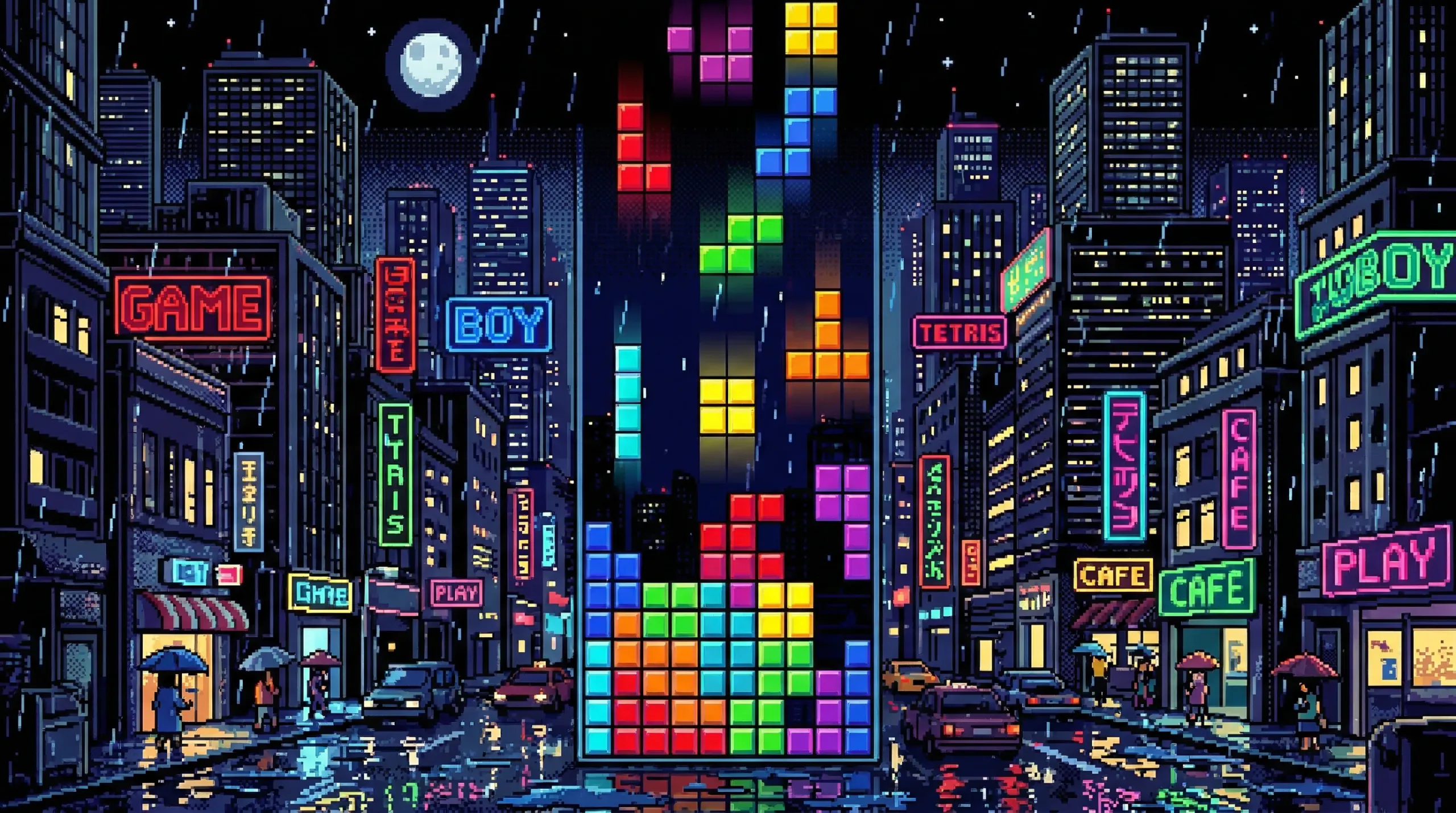
There is an argument to be made that without Tetris, the Game Boy might never have become the defining handheld gaming device of a generation. When Nintendo bundled the Russian puzzle phenomenon with its new portable console in 1989, the pairing proved to be one of the most inspired decisions in gaming history. Tetris — designed by Alexey Pajitnov at the Soviet Academy of Sciences in 1984 — was already a sensation on home computers and arcade machines, but it was the Game Boy version that truly brought it to the masses. Over 35 million copies were sold, cementing its place as the best-selling Game Boy title of all time and one of the greatest games ever made.
The premise of Tetris could not be simpler: geometric pieces called tetrominoes fall from the top of the screen, and you must rotate and position them to complete solid horizontal lines, which then disappear and earn you points. Lines completed simultaneously score exponentially more points, with the legendary Tetris — four lines cleared at once using the long I-piece — being both the most rewarding and the most satisfying play available. As play continues, the pieces fall faster, demanding quicker reactions and sharper spatial reasoning. The game ends when pieces stack to the top of the screen.
The Game Boy version of Tetris was developed by Nintendo R&D1 and Bullet-Proof Software and is widely regarded as the most polished early port of the game. The controls are responsive and precise, the piece rotation system is intuitive, and the difficulty ramp is perfectly calibrated to create that essential quality of all great Tetris ports: a flow state where time evaporates and you play for just one more line, then one more after that.
The Game Boy version introduced one of the most enduring features in competitive puzzle gaming: two-player versus mode via the Game Boy Link Cable. Completing lines sends garbage lines to your opponent’s field, adding a delicious layer of offensive strategy to an otherwise solo experience. This mode transformed Tetris from a personal challenge into a social phenomenon, and its influence can be seen in every competitive Tetris title since.
Type A is the classic endless mode, climbing ever-higher levels until the stack overwhelms you. Type B tasks you with clearing a set number of lines on a pre-filled board — a discrete challenge mode that provides a different kind of tension and makes the game ideal for quick play sessions during commutes or breaks, perfectly suited to the Game Boy’s portable nature.
The ability to choose your starting level means both newcomers and veterans can engage on their own terms. Starting at a higher level with faster-falling pieces is a satisfying challenge for experienced players, while beginners can learn the fundamentals at a comfortable pace before escalating the difficulty.
The Game Boy’s four-shade monochrome display suits Tetris perfectly — the geometric simplicity of the tetrominoes is rendered with complete clarity, and the playing field’s borders and stack are always legible even on the original hardware’s non-backlit screen. The music, particularly the iconic Korobeiniki theme (known to most players simply as the Tetris theme), is one of the most recognisable pieces of video game music ever composed, a Russian folk melody that has become inseparably associated with falling blocks and puzzle-solving the world over.
Tetris on the Game Boy is not merely a great game — it is a cultural artefact. Its bundling with Nintendo’s handheld created a feedback loop of casual adoption that expanded gaming’s audience beyond dedicated enthusiasts to commuters, parents, and people who had never considered themselves gamers. The title has been studied by neuroscientists, featured in documentaries, and inspired competitive communities that persist today. Its influence on subsequent puzzle games is immeasurable.
Tetris on the Game Boy is one of those rare games that transcends its platform, its era, and even the medium itself. If you own a Game Boy and do not own Tetris, you are missing the single most essential piece of its library — a game that remains as playable, compelling, and addictive as the day it launched.
To view the product page for Tetris please click here