Shop Catagories
00

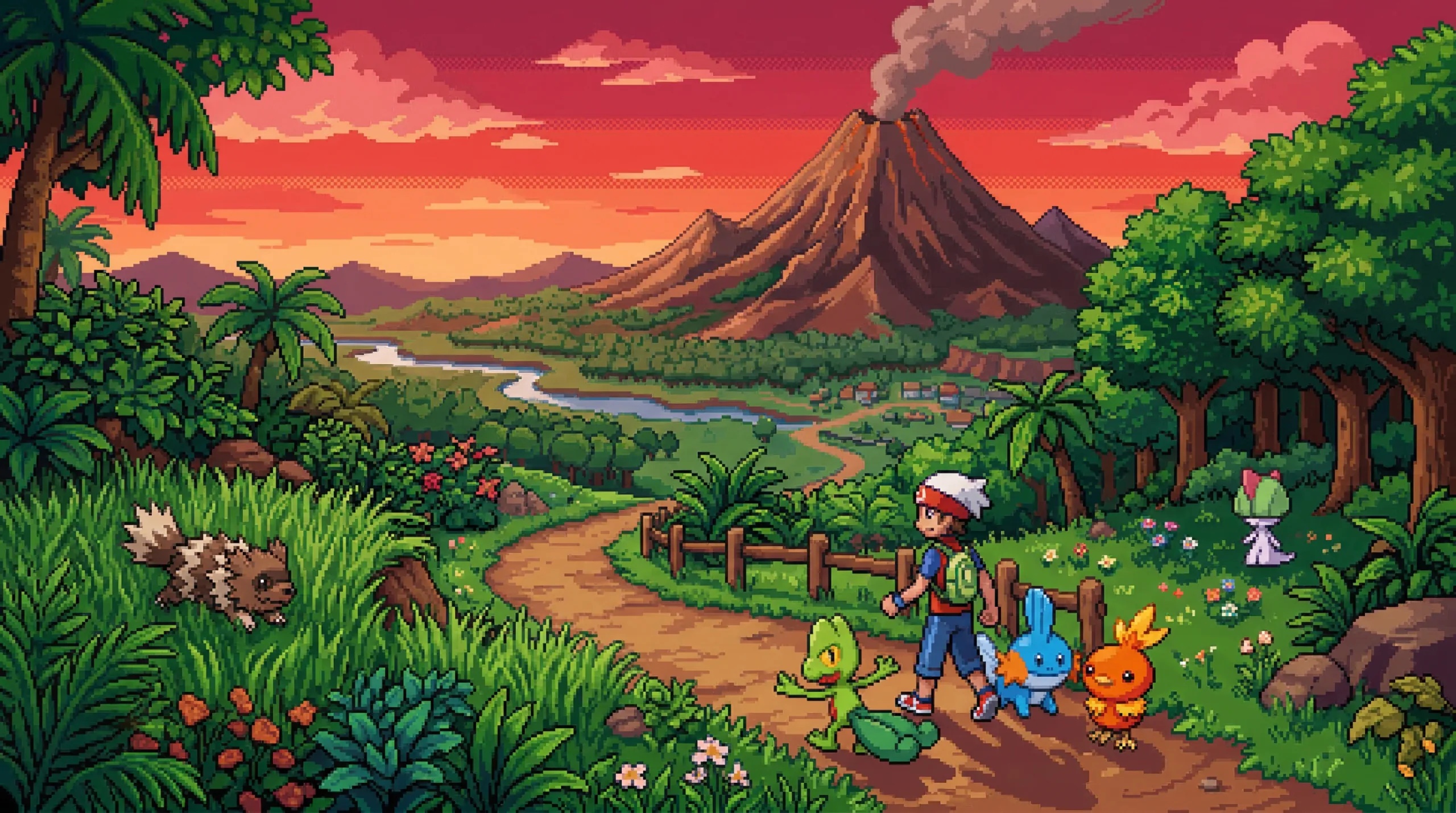
When Pokemon Ruby launched alongside Sapphire in Japan in November 2002 — and in Europe and North America in 2003 — it represented the most ambitious evolution of the franchise to date. Arriving on the Game Boy Advance with full-colour visuals, stereo sound, and the brand-new Hoenn region to explore, Ruby introduced a generation of players to the concept that Pokemon could look, sound, and feel genuinely modern. More than twenty years on, it remains one of the most beloved entries in the mainline series.
The player arrives in the Hoenn region after their family relocates, and is quickly drawn into a conflict between two rival criminal organisations: Team Magma (in Ruby) and Team Aqua (in Sapphire). Team Magma seeks to use the legendary Pokemon Groudon to expand the landmass, believing more land will benefit humanity. This moral ambiguity — a villain team with an arguably coherent ideology — was new to the franchise and gave the narrative more sophistication than earlier entries. The legendary Groudon serves as Ruby’s mascot and centrepiece encounter.
Pokemon Ruby built on the Gold and Silver framework while introducing numerous innovations that would define the series for years.
Ruby introduced Double Battles — encounters in which two Pokemon battle simultaneously on each side — fundamentally changing the competitive meta. The additional layer of team synergy, targeting choices, and spread-move strategy transformed how players thought about team construction.
Every Pokemon in Ruby received a passive Ability that activates under certain conditions — a game-changer for competitive play. Combined with the Nature system (which boosts one stat while penalising another), these additions created a depth of character customisation unprecedented in the series.
An entirely optional but richly developed side activity, PokeContests challenged players to present their Pokemon in categories like Coolness, Beauty, and Toughness. This non-combat avenue of engagement broadened the franchise’s appeal considerably.
The leap from Game Boy Color to Game Boy Advance was dramatic, and Ruby takes full advantage. Pokemon sprites are detailed and expressive, the Hoenn region’s diverse environments — volcanic routes, underwater passages, treetop villages — are visually distinct and beautiful, and the battle UI is clean and intuitive. The musical score is exceptional, with Hoenn’s route themes and the legendary battle music frequently cited among the franchise’s finest compositions.
Pokemon Ruby introduced mechanics — Abilities, Natures, Double Battles, and the EV/IV refinement system — that defined competitive Pokemon for over a decade. The Hoenn region itself received a full remake in Omega Ruby (2014), testament to its enduring popularity. For many players of a certain age, Ruby is their definitive Pokemon experience — the game that accompanied them through adolescence on a GBA in a coat pocket.
Pokemon Ruby is a landmark game in one of gaming’s great franchises. Mechanically rich, visually beautiful, and home to one of the series’ most beloved regions, it is essential for any Pokemon fan and any collector of Game Boy Advance classics. The Hoenn region awaits.
To view the product page for Pokemon Ruby please click here