Shop Catagories
00

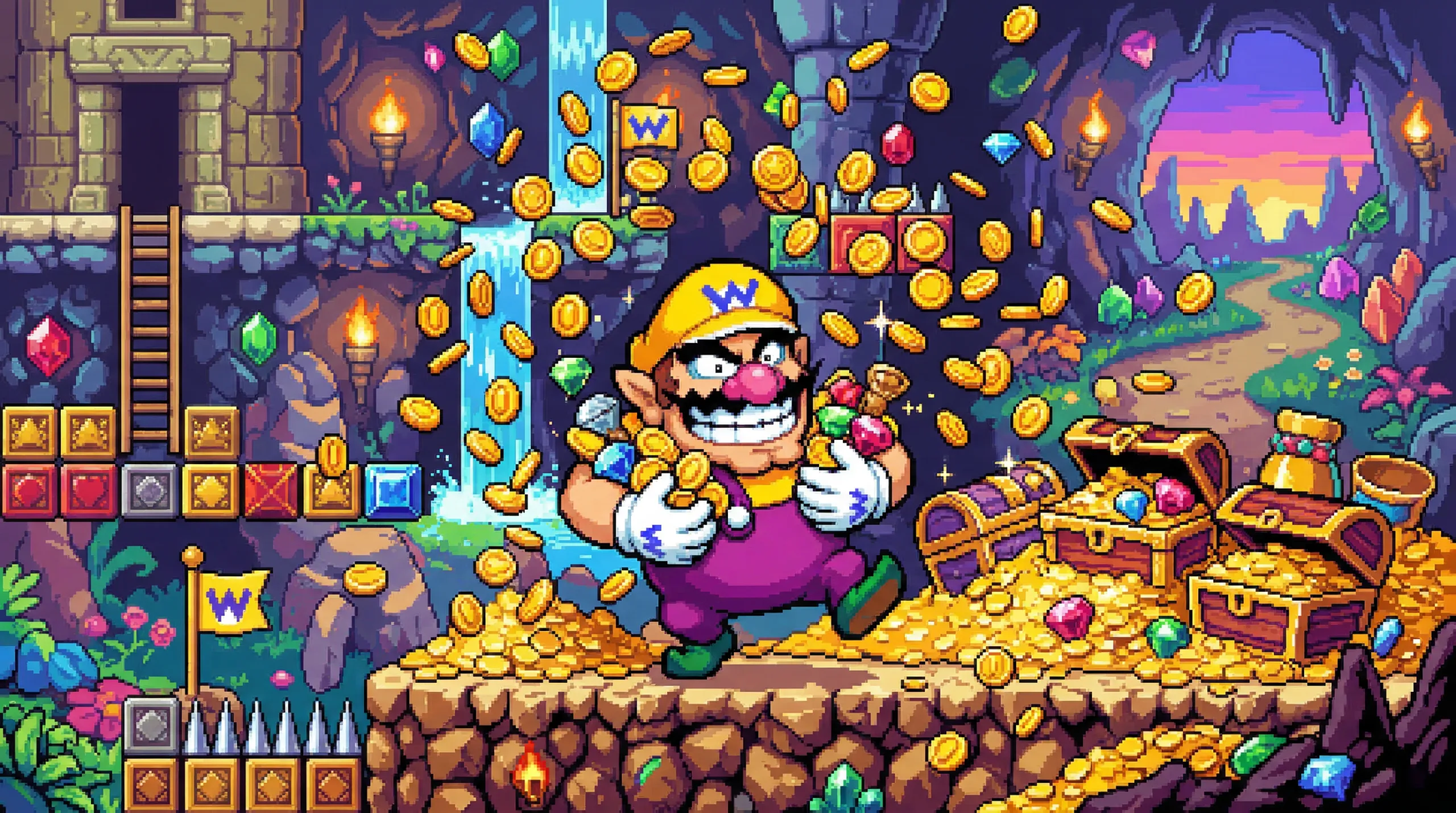
Nintendo’s yellow anti-hero Wario has always occupied a gleefully subversive place in the Nintendo universe — greedy where Mario is heroic, cruel where his rival is kind, and motivated entirely by the accumulation of treasure. Wario Land 2, released for the Game Boy in 1998 and updated for the Game Boy Color the same year, took that subversive personality and built one of the most mechanically inventive platformers in the system’s library around it. With a central gimmick built on the idea that Wario cannot die in the conventional sense — and that enemy attacks transform him in ways that become gameplay tools — it stands as one of the most creative design achievements in the Game Boy’s history.
The story begins with the Black Sugar Gang, a crew of pirates led by the villainous Captain Syrup, invading Wario’s castle while he sleeps. By the time Wario wakes up, his treasure has been stolen and his home taken over. What follows is Wario’s characteristically furious — and characteristically self-interested — campaign to reclaim his castle and exact revenge on Syrup’s gang. The story is told with humour and a light touch, and Wario’s motivations (pure greed, wounded pride) are refreshingly honest compared to the more noble quests of Nintendo’s other platformer heroes.
The defining mechanical innovation of Wario Land 2 is its approach to damage. Wario cannot die — but enemy attacks transform him in ways that create gameplay challenges and, crucially, sometimes open new paths. Being set on fire, for example, turns Wario into a flaming torch that can burn obstacles. Being inflated by a puff enemy lets him float to reach high platforms. These transformations make encounters with enemies a puzzle rather than a threat, fundamentally changing how you engage with the game world.
Each enemy type induces a different transformation with different movement properties and capabilities. Zombie Wario can walk through walls; Flat Wario can slip through narrow gaps. The game is built around discovering and exploiting these transformations, and the level design consistently rewards creative thinking. This system is so elegant that it has influenced platformer design thinking for decades.
Wario Land 2 features a branching path system where choices made during levels lead to different subsequent stages. Multiple playthroughs are required to see all of the game’s chapters and endings, giving it exceptional replay value. Hidden treasure chests scattered throughout encourage thorough exploration of every corner of each level.
The game’s boss encounters are inventive and memorable, requiring players to identify specific attack patterns and use Wario’s strength-based moveset creatively. Unlike the transformation sections, boss fights restore a more conventional sense of challenge — though Wario’s invincibility to death means that losing ground is always recoverable.
Wario Land 2 was released in both original Game Boy and Game Boy Color versions. The GBC edition adds a full colour palette that brings Wario’s world to life with vivid greens, purples, and the golden gleam of treasure. The sprite animation is fluid and expressive, capturing Wario’s exaggerated physicality perfectly. The soundtrack is upbeat and suitably brash — bold, punchy compositions that fit the anti-hero’s personality.
Wario Land 2 is consistently ranked among the finest Game Boy Color titles and is a landmark in Nintendo’s platformer history. Its no-death transformation system influenced subsequent Wario Land titles and has been cited by designers across the industry as an example of constraints used creatively. It demonstrated that the Wario series had a distinct mechanical identity separate from the Mario games that spawned it.
Wario Land 2 is a genuinely brilliant platformer — inventive, funny, and mechanically sophisticated in ways that still feel fresh today. It is one of the essential Game Boy Color experiences and a must-own for fans of creative, thoughtful platforming design.
To view the product page for Wario Land 2 please click here