Shop Catagories
00

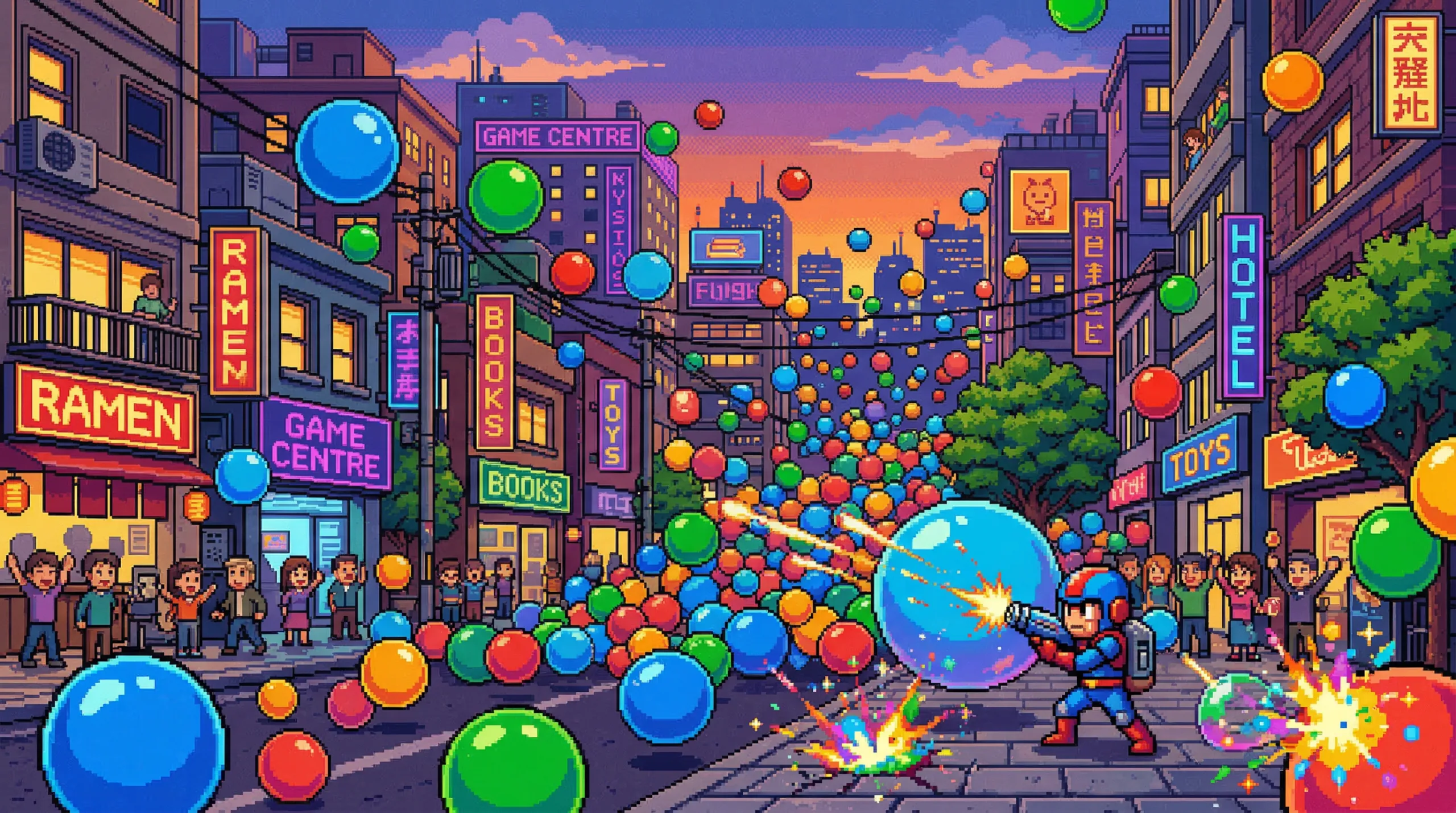
Pang — known in North America as Buster Bros. — is one of those arcade classics that translated beautifully to handheld play. Originally released in arcades by Mitchell Corporation in 1989, the game found its way to a huge number of platforms, and the Game Boy version, released in 1991, managed to capture the frantic bubble-popping action in impressive fashion. For fans of the original coin-op, picking up Pang on the Game Boy was an easy decision — and decades later, it remains one of the most satisfying pick-up-and-play titles in the handheld library.
Pang is a single-screen action game in which players take on the role of brothers travelling the world to pop oversized bubbles threatening famous landmarks. Each stage presents a different backdrop — from the Eiffel Tower to Mount Fuji — and tasks you with using a harpoon gun to split and ultimately destroy every bubble on screen. Large bubbles split into two medium-sized ones when hit, medium into small, and small ones vanish entirely. The challenge ramps up quickly as more bubbles appear and movement patterns grow increasingly unpredictable.
The core loop is deceptively simple: fire upward, dodge bouncing spheres, collect power-ups. Yet mastering Pang requires quick reflexes, spatial awareness, and smart use of the limited screen real estate the Game Boy provides.
Popping bubbles occasionally reveals power-ups such as a wire that pins your harpoon to the ceiling for a temporary barrier, a double-shot, and a starburst that clears multiple bubbles at once. Choosing the right moment to grab or ignore a power-up is a key tactical decision.
Using the Game Boy Link Cable, two players could join forces to tackle stages together — a feature that was genuinely unusual for a 1991 handheld title. Co-op play adds a layer of chaos and fun that significantly extends the game’s replay value.
The game’s difficulty scales naturally through its world-spanning stages. Later levels introduce faster bubbles, narrower platforms, and more hazardous layouts that demand near-perfect play. This progression keeps veterans engaged long after beginners have put the cart down.
Considering the Game Boy’s 160×144 monochrome display, Pang looks remarkably clear and well-defined. The bubbly enemies are easy to track, the hazard layouts are legible at a glance, and each stage’s landmark backdrop adds welcome visual variety without cluttering the play field. The soundtrack is catchy and upbeat — a slightly simplified rendition of the arcade tunes that does a solid job of keeping energy levels high during intense runs.
Pang on Game Boy is a snapshot of an era when arcade ports were judged on how faithfully they captured the spirit of the original rather than its graphical fidelity. This version succeeds on those terms. The franchise has been revived periodically over the years — including the well-received Pang Adventures in 2016 — but many fans maintain that the simple, pure design of the early entries is still unmatched. The Game Boy port helped introduce the series to a generation of portable gamers who might never have seen the inside of an arcade cabinet.
If you enjoy arcade-style action games with a satisfying score-attack loop, Pang on Game Boy absolutely deserves a place in your collection. It is accessible enough for newcomers, deep enough for high-score chasers, and short enough per session to fit any commute. A timeless pick-up-and-play gem.
To view the product page for Pang please click here